Showing posts with label Abuse. Show all posts

Thursday, October 2, 2014

Draw Reins and Dressage - Who'd a Thunk It?

 This picture is from the FEI World Cup Dressage Final for Young Riders Show, Frankfurt, Germany Dec. 2010. Yes, this is a class. OK, very minimal research tells me this must be the warm-up arena. My first clue would be the fact that dressage is not a group class, the second would be the leg wraps and the third (I hope) is the butt-load of crap hanging off the horses head.


From what I understand, these are junior riders actually competing in a class. Not your neighborhood 4H, either (which of course would never allow their youth riders to compete IN DRAW REINS), but the FEI World Cup for Young Riders.

The next time somebody tells me about a horse that's been "cowboyed," I'm sending them this.
Better cowboyed than dressaged I'm thinking.

Truth? There are stupid people in every discipline. It isn't the saddle that makes the horseman.

Wednesday, June 11, 2014

No Giant Hats and Mint Juleps for This Chickie

I waited until after the last race and let the excitement and conversation die down. I didn't want to ruin the fun of following yet another Triple Crown hopeful for anybody else. There was no reason to insert my opinion. To be honest, I'm not 100% sure what it is. What I do know is this. I am done with racing. I didn't watch, read or discuss the horses or the races with anyone.

It's hard. The most influential books in my young Horsaii life was Walter Farley's The Black Stallion series. He described races so exciting I would find myself jumping up and down on the couch, clutching my book and screaming, every single time I read them. I think the last time I was forty or so. 

This is probably the most exciting television moment of my life.


I started becoming more aware of the lives of race horses to a large extent from Cathy Trope and Her Fugly Horse of the Day blog.

I learned about a mare, named Press Exclusive,  with nearly half a million dollars in earnings and nine foals on the ground, getting trampled on a slaughter bound truck.

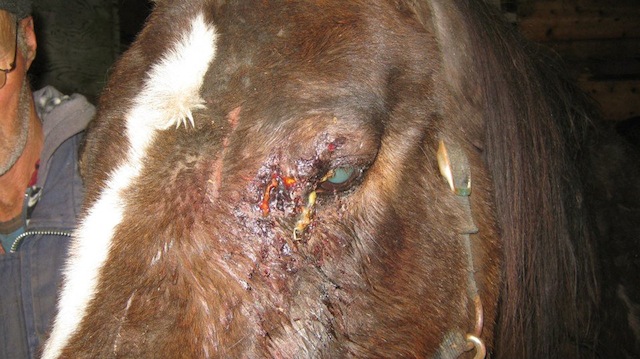
Her eyes were swollen shut from blunt trauma sustained enroute to the slaugherhouse

This is what she looked like when she was unloaded. She also sustained four fractured ribs and was covered head to toe with deep cuts and abrasions. She had a body score of zero. Yes, zero.


“Two-year-olds, as we know, can be here today and gone tomorrow.” -Gai Waterhouse, leading racehorse trainer."

Then, I started to learn about the injuries sustained by these horses from beginning their careers as two-year-olds.

In Australia, a study of two and three-year-old thoroughbred racehorses reported that 85 percent suffered from at least one episode of illness or injury.

See more eye opening stuff here: http://www.horseracingkills.com/the-issues/two-year-old-racing.

Did I mention drugs? Drug use is so prevalent race horses are no longer being bred with concerns over long term health. The standard practice is to race them young, race them hard and then drug the crap out of them until they die. 


None of this stuff is new anymore. I've been uneasy with the race horse industry for many years. I saw improvements, rescues trying harder, signs of the racing industry stepping up....and it made it easier to just feel uncomfortable, but still catch those races, have a favorite, root for an injured horse without looking too closely.

This year I learned about something I had never heard of before.

Have you guys heard of Nurse Mare Foals?

I hadn't.

According to The Last Chance Corral Website (http://www.lastchancecorral.org/foal-rescue)

A nurse mare foal is bred and born for the sole purpose of bringing it's mother into milk. This milk is produced to nourish the high-bred foal of another mare. The original foal is usually pulled from the nurse mare and killed.

The big buyers into this practice are thoroughbred breeders. The Jockey Club requires that mares are bred by live cover. In order to keep those babies popping as close to January 1 as possible, they are routinely bred back during their foal heat. So, mares can be shipped to be bred as early as seven days after foaling.

The newborn foals are too fragile and valuable to be shipped anywhere. So, their mom is hauled away, baby is left behind and in comes the Nurse Mare. Her brand new baby was just taken out with a sledge hammer, or tossed outside to starve to death, and she is given the thoroughbred baby instead.

I had no fricking idea. Something inside me snapped and I am done. I won't watch another horse race. Unless it's a couple of buddies taking off down a dirt road. I'll still read my beloved Walter Farley, but I'll hold firm to my childhood conviction that Alec and Henry took care of every horse that came though their hands.


I won't ruin the conversations about the next triple crown winner around the office. I won't show up and spoil anybody's Big Hat Party on Derby Day. But don't talk to me about horse racing. Because I am done.


Saturday, May 17, 2014

Puppy Mill Start Up Kit


For only $1100, you too can start up your own animal shop of horrors.


http://cosprings.craigslist.org/grd/4470263826.html

 Stainless Steel Professional Kennel System w/ rack - $1100 (Sedalia)


I have a 8 stainless steel kennels with rack and space for storage. Perfect for serious rabbit breeders, shelters, groomers. Sanitary, easy to clean system keeps animals dry while washing away waste and dropped food. Keeps stock healthy and safe.

Solid stainless with heavy duty gate fronts, complete ventilation all the way around; feeder slots with feeders, accessible from the outside so feeding can be done without opening the doors (two feeders are missing, but easily replaceable), feeders are removable for easy cleaning. Each cage can slide out of the rack for transport and has hinged handles on both sides for easy carry. Built in kennel card slots. Additional slot for exterior water bottles for those lacking a way to hook up the automatic water system.

The bottoms are square cut heavy duty NON WIRE stainless grates so waste drop through while still providing firm footing for animals.

Stainless steel rack has wheels with brake stops and an "easy clean system". Levels are slightly sloped (degree of slope can be changed), so with a hose beginning at the top, washes waste from all levels while keeping the animals 100% dry.

Factory water system in the rack provides continued fresh water to all cages, one nipple does need to be replaced.

This is a professional rack and kennel system.
Has been housed indoors.
Very high quality. heavy duty. You won't be disappointed.
Rack is over 5' high, overall length is ~6'. You'll need a truck or trailer to move.
Delivery may be possible depending on location for an additional $75 for fuel costs in the diesel.
$1100. 

[I am local, although my phone number is not - see contact box for contact]

Saturday, October 19, 2013

The Ol' Yank N' Spur - Part Two

"So, when you see a trainer or horse owner using a method that you find abusive and/or unacceptable, what do you do? I'm asking you personally, Mugs."

"I want to own that stallion who stands in a crowd without lifting a nostril.. but I don't want to put my horses through what it took to get (the majority)of them there. I have ridden some "good" horses but most (not all) had very little personality.. or at least didn't show it.
I want my horses to be rock solid citizens.. but I enjoy it when they are individuals as well.
So, right now, I own some brats with manners. Stuck in the middle..."

These two comments dovetail straight into the crux of what I'm working through here. It makes me happy to see I've got people thinking and wondering like I am.

First, I'll answer the question, and get that out of the way. There is a HUGE difference between abuse and methods I find unacceptable.

Abuse? Starvation, treatment that causes crippling or death, behavior that endangers other horses or people, I call the authorities. That might be the police, a barn manager, the show representative at a horse show, local animal control or a newspaper. I ask what is going to be done and when, then I follow up to see that it happened and what the result was.

I have only been in a situation where I had to physically intervene twice. I was on a walk in a neighborhood I didn't know very well. A group of very young (four or five-years-old and down), very dirty children were torturing a puppy, chained in the middle of a yard, with sharp sticks. Not only were the children jabbing him repeatedly in his belly, but the violence was increasing at an incredible pace. The puppy was screaming,  the children were laughing, then I was shouting at them. There wasn't an adult in sight.
I went in the yard, knocked on the door and waited until a very disheveled, vague woman came to the door. I told her what the kids were doing, she went in the yard and started yelling at the kids. There was no food, shelter or water for the puppy. I left, went home and called our local Humane Society and DHS. The puppy was relinquished, the "daycare" was shut down and the woman and her own children were dealt with by Social Services.
Another time, I stole a dog tied to the side of a trailer on a two-foot chain. He was standing up to his knees in poop. Again, no food, water or shelter and he had body sores from foot to belly. I took him, trained him and a year later found him  home, where he lived happily for the next 12 years.

If I see a horse starving in a field I will watch him. If after 60 days I don't see an improvement I call my brand inspector, who is more than willing to wade into the legalities of letting livestock starve.

Methods I find unacceptable? I only comment if I am asked my opinion, and then only to the person who asks. In the old days, my students and clients heard me loud and clear, because that's what they paid me for. Nowadays, I have to be much more careful. I've made the mistake  of offering my insight in response to behavior or approaches I clearly saw as misguided. They were met with massive resistance and a touch of hostility. So, even though I was being told the story, my input beyond, "Uh huh," was very clearly unwelcome. If I alienate someone, I lose my chance to influence them. So, I don't offer unless specifically asked anymore. I just write.

Which brings me back to my original thoughts. How do we decide what is abuse, what is tough training, what is unacceptable and what, in the long run, might have been OK? I am eternally confused on this one.

Here are some of the scenarios that have made me slow down my conclusions and rethink lots of my former opinions. I'm writing these in no particular sequence.

1. This 10-year-old horse and 40-year-old rider came in for training.
"My horse was abused before I bought her. She is head shy, freaks when she's tied, can't tolerate being brushed, having her ears or poll touched, is terrified of men in baseball caps, ropes and loading in the trailer. She will only walk when I ride her, she rears if  I try to trot."
The owner was brand new to horses. For her first horse experience, she had gone to the local auction and bought two of the most starved, spooked, panicked animals of the day -- neither were ridden into the sale pen. The mare she brought me had had a foal a few months after purchase. She had owned them for a year when I began working with her.
She left the mare, with lots of kisses, tears and fuss. The mare pinned her ears and threatened to bite.
After thirty days the mare was fine.
After 60 days she was great, as far as her crappy conformation would let her be anyway. WTC, calm, safe.
I never needed to do anything beyond my normal training. I treated her like an unbroke youngster, she responded, and there you go. She sucked back one time on the tie rail. I ignored her, she stepped forward and that was the end. She was tied next to the guys while they were drinking beer and playing H.O.R.S.E., er, practicing roping with the plastic cow head stuck in a hay bale. Suddenly, ropes and men were moot.


2. I came into the arena on a colt. The Big K was riding Buck, a teen-aged cow horse K had owned and trained for his wife. It was very clear K was in an absolute fury. Buck had his superiors in both the AQHA and NRCHA, and a AQHA World Championship under his bridle. He had been fat, happy and retired until his new owner, a primary client of K's, had written a check so big they couldn't turn it down.
So, I was taken aback to see K beating the crap out of Buck. He spurred him forward, yanked him into the ground, spun him with a jerk to his heavy bit, whipped him heavily with his romel, you get the picture. The owner stood at the rail, silent, miserable, almost crying. By the time K was done, Buck was trembling, exhausted and white-eyed. He was also upright in the bridle, collected, soft and compliant.
K stepped down, his face red, his eyes cold and snarled at the client. "If you would ride him right I wouldn't have to do this."
He left Buck standing in the middle of the arena and left. His rage was obvious, it took a second before it registered that it was directed at the client.
"That should hold him through the weekend (coming show), then she can go back to loving him until the next time he pisses her off," he said in passing. He didn't come back to work for an hour.

3. A consistent national champion trainer (top five in the country for many years) was unloading horses at an event at about 2 a.m. There was a huge ruckus in the trailer. Those who were awake were immediately drawn to the show. He appeared at he loading ramp, beating an equally famous stallion with a logging chain. The fight and the beating went on for another few minutes until the stallion submitted, head down, quiet, licking and chewing. The horse was heavily blanketed, there would be no marks.
Nothing was said, a few eyebrows were raised, but it all took place at the training barn.
The next day the duo won the whole shebang. The trainer is still a top winner and the stud is sound, retired, loved, and a million dollar sire.

4. A young, decently bred horse was bought by an intermediate rider who wanted to raise and train a horse using Natural Horsemanship methods. The plan was to do it without assistance other than local clinics and videos. Two years later the horse threw the rider into a fence, resulting in some pretty serious injury. All work stopped for another year. I was called in to consult (free mind you, I was retired).
I met an amiable, soft, 16.3 hand 1300 pound spoiled monster. He bumped, nipped, stomped, pawed, shoved....I could go on. He gave his head like a cotton rope, right up to his lock and loaded shoulders and legs.
One 30 minute round pen session told me the horse was kind, biddable, interested and athletic. I evaluated his behavior, watched how the owner handled the horse and said I couldn't help, they needed to invest in a trainer and take as many lessons with said trainer as possible.
Two years later, the horse was 7, still not broke and being put up for sale. You see, he was kicking and injuring people now, and was too dangerous to handle.

5. A couple of boarders were trying to load an unwilling horse into a trailer. They had a huge crowd of "helpers." The situation was escalating. The horse was rearing, kicking, falling over backwards...you know, trailer loading nightmares.
One of the helpers came up to me and said, "Do you know what to do?"
"Yes."
"Would you go help them?"
I was very hesitant, the actual owners hadn't asked for help, and I said as much.
"Somebody is going to get hurt, please go help them."
I approached the chaos, and offered to help.
The owner spun around, and said, "If I had wanted help I would have asked."
Her clenched fists told me all of her anger, frustration and embarrassment was about to be unloaded on my face. I turned to go, her horse unleashed with a double barreled kick and caught the owner in the kidneys.
The horse was eventually loaded, the owner was OK. The horse also, eventually, learned to load reliably and I was forever blamed for the owner getting kicked.


There you have it. I have left out my opinions then, my opinions now, and the conclusions I came to. I am really interested to read your thoughts and reactions. Next post I'll come in with what I thought then and what I think now. Even if it's the infamous, "I dunno."

Oh yeah,
"I want to own that stallion who stands in a crowd without lifting a nostril.. but I don't want to put my horses through what it took to get (the majority)of them there. I have ridden some good horses that had very little personality.. or at least didn't show it.
I want my horses to be rock solid citizens.. but I enjoy it when they are individuals as well.
So, right now, I own some brats with manners. Still a mugwump..."

I changed this comment just enough to make it mine. Of course, I have a feeling my idea of manners might be a little different than the original author's.


Wednesday, June 26, 2013

Damage Control

This video is not for those with weak stomachs. 
A fellow blogger sent it in, with the question, what do I do now?
She had been riding the horse with a mechanical hackamore, but wanted to advance her horsemanship beyond it.
The bits weren't working out at all, and then the vet found this...


His advice? Use whatever works.
Thanks, vet.

First of all, let's think about how this horse got where he is today.
I do believe he was a rope horse.
This doesn't necessarily have anything to do with that horrific injury, but the roping reins might.
Also, many rope horses are trained to rope and only rope.
They are one-leaded, their life involves standing tied, warming up and blasting out of the box.
The tie downs used for "balance" (don't get me going), create a horse who travels hollowed out and pulling with his front feet instead of with a rounded back and pushing with his hind legs.
This is WHY you see so many high-headed rope horses, complete with an over developed muscle along the bottom of the neck and none along the crest. The head set and neck are not a reason to need a tie-down as we are often led to believe, pushing against the tie-down creates the whole mess.
Not all rope horses are trained this way, the barn I keep my horses at has a roping trainer who makes an all around broke horse, then teaches it to rope.
All his horses know both leads, spin and stop. They go out on the trail. They don't wear tie-downs. He's got ropers flying in from all over the country to buy his horses and some absolutely gorgeous stock in training, so I'm thinking he's taking the right approach.

I'm not going to jump to the conclusion the horse with a damaged tongue was abused. It's tempting to go there, but probably not what happened. Not intentionally anyway.

I knew a young woman who had a nice all-around gelding she showed in IBHA. She had the horse for several years, loved him to death, took excellent care of him and showed primarily in halter, Western Pleasure, Horsemanship and so on.

One night she was doing a tune up on her trail work. She was riding in a snaffle and roping reins.She hopped down to change a few of her obstacles, leaving her good gelding standing in the middle of the arena, waiting patiently for her as he always did.

He lowered his head to the ground, the roping reins slid over his ears and he put a foot through them. He jumped back, but the rein was so short it yanked on his mouth and he panicked. By the time his owner got him undone the snaffle had severed his tongue. Not just cut it, but ripped it in two.

No one beat him or ripped at him with a big old western bit (a favorite reason from folks who know nothing about our bits). He was in an egg butt snaffle. The most damage I have ever seen done to  horses tongues has been with broken or chain mouthpieces.

If a horse in a shanked, broken mouthpiece bit and a tie-down, trips at a full run and piles into the dirt, he will try to regain his balance by slinging his head. He will be stopped by the tie-down and fall with the bit cranked across his tongue.  I've seen some pretty serious wounds happen to tongues this way. Then there's your basic, tie the horse with the bridle reins approach. My guess is this is the primary way these accidents happen.

From what I was told, he is afraid of ropes, so I'm going with an arena accident. A roper is not going to make a horse afraid of ropes through abuse or any other means, that would kind of defeat the purpose. You know, of roping stuff. But, if a horse ends up with a scarred tongue and a fear of ropes, no matter how it came about, it's a good way to end up being sent down the road.

So, our reader now has a tough, stiff riding horse with a severely damaged tongue. What should she do?

If she was going to trail ride, I'd say stay with the mechanical hackamore. I don't care for them, but a tool is only as dangerous as the hands using it.

The thing is, she wants to do lateral work, develop her hands and feel and get her horse working the way a good horse should. She's very aware this won't happen in a mechanical hackamore.

Personally, I don't think he should ever carry a bit again. I think the damage to his tongue is too severe for him to ever be comfortable in a bit, it could even be excruciating, which means dangerous.

So what's next?

Go all Parelli and ride him with a rope halter?

If that's what you want, go for it, you'll have lots of company. I'm more of a traditionalist. I want to actually do stuff, like ride.

So I did a little research and found some alternatives for this horse.

Here's what I came up with. I've used some of these tools and others I haven't tried...


Go Nekked - Let's get real here. Stacey did not start this horse bridleless. Riding like this is not for the faint of heart.

Neck rope - This is the step between bridle and bridleless. Again, not a method I suggest for most riders.

Tack rein: When I was a little horseless child in Boise Idaho, I ran with a kid named Tammy McClure. I do believe she's a pleasure horse trainer now. Anyway, she had horses and rode with a riding group, Ehcapa (http://www.youtube.com/watch?v=5HfUsyZ9tMM) where they rode in the Rose Bowl Parade, jumped, did drills, and just about anything else you can think of bareback and bridleless. They all rode with a tack rein, a leather strap with studs in it that hung around the horse's neck.

I was so jealous I could spit. she was so amazingly cool it just killed me. Every once in a while I got to ride with her, all we had was the tack rein. It was awesome. The only reference I could find to the tack rein is here http://buckarooleather.blogspot.com/2011/07/bridleless-rein-tack-collarrelief-from.html
I don't remember actual tacks in the rein. They were more like a round stud, or the dots on an old style western bridle and it was a simple leather strap.

Anyway, I haven't used one since way back then, but we were little kids tearing around and I had no experience at all. The horses were fine and nobody died...now I'm wanting to rig one up. 

Grass hackamore: Also known as a loping hackamore, this is pretty much a bosal that works like a snaffle. Very gentle, very light, don't plan on much whoa, because there isn't any.Cutters often use them on their youngsters and there, they are an effective tool. They guide right to left without breaking the focus or frightening a young horse. http://www.nrsworld.com/dennis-moreland/grass-hackamore-w-grass-reins-3183

Bosal : One of my favorite training tools, it has taken me quite a few years to get a solid handle on it. The bosal works off the nose. The reins are attached under the chin. Steering and stopping are done mostly off weight aids and guiding the nose. I put my youngsters in a snaffle for a year or two before I go to the bosal. My personal philosophy is to get the shoulders with the snaffle and then the nose with the hackamore (bosal). The bosal works the opposite of a ring snaffle, with the pressure pushing against the outside of the face instead of pulling the inside. This gets them neck reining even though you're still riding two handed. http://calclassics.net/php/buy/bosals/

Sidepull: I have started many colts in a sidepull, the rein action is similar to a snaffle, and I have a little more oomph than in just a halter. It also works off the nose as well as the sides of the face. As long as the rider doesn't hang on a horse's face, this is a good tool. It consists of a headstall with a noseband made of leather, rope, or braided rawhide. The side pull has rings or loops on the sides of the noseband to connect the reins. Some sidepulls are simply a rope halter with rings tied into it. The reins apply direct contact to the side of the noseband giving considerable turning control but limited stopping. http://www.horsemansshop.com.au/index.php?main_page=advanced_search_result&search_in_description=1&keyword=sidepull
I haven't used a an Indian hackamore, but I see the logic, it's close to a bitless bridle. If I wanted to mess around with one, I would try this one.
http://www.ebay.com/itm/Jose-Ortiz-100-Hand-Braided-Rawhide-Indian-Hackamore-8-Plait-All-Natural-/161024490839?pt=LH_DefaultDomain_0&hash=item257dcebd57

Scrawbrigs: This is an English version of the bitless bridle and I know nothing about it.These act on the nose and chin. The reins are attached to a strap which runs under the chin, and tightens when pressure is applied to the reins. Better brakes, but not very sensitive in the steering department. http://www.onestopponyshop.co.uk/superbasket/product.php?product=375

Crosspull: The Crosspull is the official name for Dr. Cook's bitless bridle.This bridle acts by tightening at key pressure points on the horses head, dispersing pressure over the largest possible area. Unlike all other bitless bridles, this one pushes the horse into a turn, rather than pulling, which is how a bosal works. This would create a good base for neck reining. When pressure is applied to one rein, it is transferred to the opposite side of the horse's head. The most common one is the Dr Cook's, however there is also the Nurtural and the IV Horse Super Pro among others. Again, I only know about them by reading, studying, and not needing to try one for my particular purposes.

English Hackamore: A short shanked mechanical hackamore with lots of padding, it still has communication issues. Nope, haven't used this, if  I'm going to use a mechanical hackamore I'll buy one stateside. http://www.thesaddleryshop.co.uk/P/English_Hackamore-(479).aspx

German Hackamore: Same thing, longer shanks, much like our American ones. 
Meroth: The Meroth bridle is a crosspull that works on the chin groove. There is a nose band, but the majority of the pressure will come from underneath. Haven't tried it....

So how would I approach working a horse like this one, and which bitless bridle would I use? First off, I would get all my pity, angst and endless love under control by taking him out to graze and weeping softly into his mane. 

Then I would train him exactly the same way I would any other rope horse that I was transitioning over to a new discipline. I would start him over like he was a dewy eyed three-year-old. My only acknowledgement to his past would be going bitless. 

Before I go any farther I have a blanket statement to make about any piece of equipment we put on a horse's  head or around his neck, for that matter. None of them are natural. All of them can be painful or painless, DEPENDING ON THE HAND THAT IS GUIDING THEM. Please read my last sentence over and over until it is branded deep into your brain.

I may not be able to stop a runaway with a sidepull, but it doesn't mean I won't rub him bloody trying. The sidepull is not designed to stop a horse and it can sure as hell hurt one -- if I am frantically yanking on it trying to stop. I can tear a horse to pieces with a spade bit, but I won't ride my horse in one until she has had the five to seven years of education it takes for her to know how to use it. If she's not a good candidate for a spade, she won't ever go in one.

Please don't let a sales ad or company spokesman talk you into a piece of equipment. Buy after educating yourself and truly understanding what your purchasing.

Another big pool of quicksand to duck is thinking the lighter the piece of equipment you use, the better horseman it makes you. 

There was a boarder at my first barn who liked to ride in the arena while I was giving lessons or showing a horse to clients. He wanted to be a trainer, actually, he wanted my job. He would ride around, doing exercises he had learned from his John Lyons video, riding his gelding in a rope halter with a lead rope, then eventually, taking off the halter and riding him bridleless.

It was all very impressive and to an educated horseman, extremely moronic behavior. I gritted my teeth and waited him out with a smile. My bosses were becoming infatuated with his deep understanding of horses. Lucky for me, the day his horse decided to come undone he was in the arena with the boss's son and their stud. The Lyons aficionado not only had no way to stop his
horse, but it had never been trained to understand who was actually in charge during a crisis. The wreck was astounding and educational, nobody got hurt and the wannabe was considered a total boob from that day forward. No horses were hurt, but there was a cracked elbow, lots of bruises and some torn out gates and fencing. Even riding a horse with nothing on his head can get him hurt if the rider is a dumbass. 

Just to be clear, I'm sure Mr. Lyons would have had a heart attack if he had witnessed this misinterpretation of his methods.

I haven't ever tried a crosspull bridle. I looked at them when they first became the rage. The first time I saw one was at a Horse Rescue I was trying to volunteer at. A brand new, never had a lesson, but adopted an angry, half-broke, three-quarter starved horse went by with a crosspull. She came back to the barn ten minutes later, at high speed, screaming and pulling on the angry horse's bridle with everything she had. 

The next time I saw her she was riding with a curb. Her horse was still angry (my guess is he was desperately wishing he had never been "rescued") but she could stop him.

Personally, I would start with a sidepull and move into a bosal, then stay there. I might play with the Indian hackamore. My reasons are pretty simple. I work off the nose and the other types get control from either the jaw or the entire head. The sidepull would educate my horse's shoulders and the bosal would educate the nose.

Anyway, I would start my rope horse with a side pull and lots of long trotting. I would ride two handed, and think about keeping a steady pace and turning lots and lots of gentle corners. Doing esses in the arena, thinking about hand and leg position, and cuing with your seat and calf will take you a long way towards beginning collection and flexing.

I would not try to stop my horse, or even slow him down, if he wanted to go, well then, we would go. the way to control your speed is with the size of your arena. Your horse will go much slower in a round pen than a rodeo arena.

I talk about all of this stuff in my colt training posts BTW.

My stops would come from my seat and a whoa, I wouldn't ask my horse to stop until he really, really wanted to. Again, my approach is somewhere in my past posts.

Active posting and keeping a horse forward though a turn will get him to pick up his back and flex at the poll. Trotting esses and zig-zags have done more to improve my horses frame than anything else I've ever done. 

Trotting is great for building muscle and balance, on horse and rider both. If you don't know how to post correctly, now is the time to learn.

I would squeeze my hands and release them in rhythm with my trot on our straightaways, along with a gentle squeeze and release from my calves. I'd be seeking a little flexion, not even asking really, just feeling around for it.

Where I would first feel some lift and flex would be through a turn. I'll relax my hands and my legs as a reward...

The give and take will never give my horse something to set against. He might flail around with his head, looking for his tiedown, but I'll be patient. Eventually he'll feel me and begin to work with me.

The rest...well that's your adventure, so get on with it.


Sunday, December 2, 2012

Swish


This is why I am so conflicted with the show circuit.
This colt is lovely.
His head carriage is much more natural than what we've seen in the last several years.
I was happy to see it.
But then I saw his tail.
His poor,mangled, surgically blocked tail.

A blocked tail hangs long and low and doesn't switch in frustration. It gives the look we stock horse people love so much, but doesn't require training a horse so at ease he runs with a quiet tail on his own. It also stops one of horses main means of communication. Blocking a horse's tail is the equivalent of an overdose of Novocaine for one of us.

"Mhuh? Glable, mleah, slomo, nee?" Drool....

You might still be talking but nobody is going to understand you.

A few injections of Everclear and you've got the look we want in western pleasure, reining, cow horse, cutting and halter. Before anybody gets too excited about me opening the door to slam western events, I hear tail blocking is now prevalent in dressage, all the way up to USEF events.

We need to keep our outrage pointed where it belongs, at anybody, in any event, with any horse, willing to damage them permanently for cosmetic purposes. It's crazy. It's the industry.

I'm going to 'fess up here. I've done it. Once. I could give you all my excuses and reasons why I did it, but I'm not. I will tell you I had it done by a veterinarian who was able to inject the horse so the effect was temporary. If everything worked out right of course. I was lucky, it was temporary, and the horse I had injected recovered completely. I'll never do it again. If I can't win because my horse rats out a misplaced
spur or a sore hock with an angry snap of her tail, then so be it. I'm not a good enough trainer to get the job done, at least as far as I'm concerned.

Before you hang me from the highest tree here, keep in mind, a lot of my opinions and thought processes come from experience, seeing the results of our idiocy, and deciding I wanted no part of it. Not from jumping on the soap box of indignant ignorance and screaming my head off. I'll be as honest with my mistakes as I am with my successes if they are helping people learn. As soon as they become a reason to tar and feather me and run me out of town, well, I'll go back to showing photos of fairy princess horses.

Tail blocking hides the myriad of unfair training involved behind winning big. It hides sore backs, over cuing, fear of being spurred until they bleed and spur stops. It covers exhaustion, fear and anger. Gums, lips and tongues ravaged by lip chains and twisted wire snaffles aren't an issue with a quiet tail.

Blocked tails hide the stress of being started too young and pushed too hard. We insist that our horses perform at mentally  impossible levels and appear happy while they're doing it. So let's go ahead and ignore the possible side effects.  How about fecal dribbling? There's a nice look for your dappled gray reining champion. Problems with foaling, impactions and spinal displacement are all a price your horse can pay for a five minute run in the arena.

Of course it doesn't hide anything, not really. If you watch long enough, you'll learn to recognize the spastic twitch of a blocked tail, trying desperately to say what needs to be said. It's like walking into a warehouse and seeing a bound and gagged woman hogtied to a chair. Her eyes are bulging out of her head, she's covered with cuts and bruises and when you see her you say, "My she has pretty hair." Because if she was in pain she would say something, right?

What seems truly crazy to me, is we're taking away our horses rudder. A horse's tail is the counter balance to their head through all those NRHA, NRCHA circles, spins and turns on the fence. How the hell is a horse supposed to give a calm and balanced performance when his tail is hanging down like a weighted baseball bat?


Wouldn't it be more interesting if there were points given for the use of a quiet tail to enhance a performance and points taken away for rider interference causing a loss of harmony?
How fun would that be?

So here you go. Can you see it? Watch the dock of his tail.


NRHA Futurity Champion


Thursday, June 7, 2012

Ears Wide Open and Mouth Shut - Roping Donkeys

I have read a lot on the blogs about the abuse of donkeys used by ropers for roping practice.

I had never been around the practice before, but the stories I read made me pretty much agree it is a horrible thing to do.


Here are some excerpts from some of the reading I had done.


" I’ve personally witnessed donkeys who were victims of roping abuse
who came to my ranch for gentling and training.   Unfortunately once again, there’s no easy “fix” from this abuse.   Although the donkey is removed from the environment which it lived in pure fear and pain,the memories will live forever in their hearts and mind.

 A huge surplus of standard donkeys in Texas and nearby states has led
to inexpensive donkeys used for practice roping.   For a mere $10.00 per donkey at many livestock auctions, some cowboys can’t seem to resist cheap donkeys to practice their roping skills on.  Once the donkey is so highly abused to the point it hunkers down in the practice pen, the donkeys are  returned
to the auction yard waiting for the next cowboy to bid on them.  And the abuse continues.   
 In some cases, ranchers don’t even bother to haul the spent donkeys back to the auction yards. Many simply drive a trailer load of donkeys to a remote location in Texas and turn them loose to fend for themselves."

   l“Horse-riding ropers used Giuseppe to practice roping. They're called either 'headers' or 'heelers,' which means they use the donkeys to practice roping cows, either their back feet or the head. Most of the donkeys used this way are crippled for life, especially if they’re laid down and stretched out. You can easily break the animal’s back,” she told me."


 One afternoon I saw a couple of donkeys in the holding pens behind the cattle chutes. 

 Uh oh. I do board my horses at a roping training facility. It looked like I was going to see firsthand the mistreatment of roping burros.

Here's what I witnessed.

There were four burros. All of them were intact jacks. Their feet were incredibly long and they were wild as Mach hares. They were extremely thin. 

The burros spent a month eating. They were roped, thrown, wormed, inoculated and had their feet done.Then they were left to eat until they had some fat on their ribs.

Once they were healthy they began training. the entire process took less than a week. The burros were herded into the arena one by one and taught to lope a large circle. This was done by having the ropers drive them in the circle them at the hip and whack them with their ropes when they tried to go off circle.

Was this nice? Well, no. Were they hurt? Nope. No rope burns, no broken legs, just driven in a circle. It didn't take the jacks long to sort things out, they are pretty darn smart.

One jack was aggressive and willing to bite. He was kicked back to the pen and not used anymore.

The next phase of the training was to rope them.

The burros were roped around the head. They were drug around until they stopped and faced the rope horse. Then they were given slack. This was a very short lesson. The burros knew to stop and face the ropers within 15 or twenty minutes.

Next the hind feet were roped, one at a time. The jacks kicked and squalled, the second they stopped they were given slack. They were not thrown. They learned to stop when their hind legs were roped even faster than they learned to face off the rope horse.

The aggressive jack went to the sale barn.

The other three spent the summer teaching colts to track, get in position and the basics of roping. Because the donkeys stopped as soon as they were roped the colts learned they could control them without having to feel much pull from the rope.

I did notice one of the Jacks got his legs scurfed up. He was put away until he healed. There wasn't any scarring, no broken bones and he healed clean legged.

By the end of the summer the burros wouldn't play anymore. So they were halter broke, then saddle broke, taught to tie, have their feet done etc.

Then they went to the sale and sold as saddle broke. They had been bought for between $5 and $25 dollars and sold for between $150 and $200.

Here's a few interesting facts I learned while I was watching all this.

BLM burros are diverted to other states and sold at public auctions by the hundreds. I'm not saying the BLM is doing this, but I don't know who else has truckloads of unwanted burros handy.

If you halter break a burro before you rope break it, it won't work. They have to be taught to be driven instead of led first.

The roping burros were very good with their feet and not spooky.

They were broke enough to periodically be tied to the cars of various people in town, all of them victims of the odd sense of humor of my barn owner. The burros were gentle and friendly enough to be led back by the very non-donkey savvy victims. 

I'm having trouble considering this practice barbaric. It seems to me, these ropers give the burros a rare chance to have a life beyond the holding pens of the BLM.


Saturday, May 19, 2012

Big Licks and Old Rope Horses


Writers block is a terrible thing.

As  you may have noticed I'm wrestling with a massive dose of it right now.

Those of you who have read this blog for any length of time will know this isn't the first time it has happened to me, I'm guessing it won't be the last.

I'm not gone, I'm not dropping the blog,I'm way too attached and have learned too much by blogging to stop.

I do have to wait out this dry gulch in my writing, but the rain always comes, so I've learned to be patient. I hope you will be too.

In the mean time, there are thoughts I want to share, and this travesty going on in the Tennessee Walker horse show world is one I can't leave alone.

Snarky Rider/FHOTD has done an excellent job of covering it, so if this subject is new to you, pop over and catch up ( snarkyrider.com), I couldn't have written a better post.

There are two subjects on animal cruelty that send me over the edge. One is puppy mills and the other is training for "The Big Lick." 


This explanation from Wikipedia  of the two categories for TWH classes tells me a lot. "Flat-shod horses are divided into trail, country, light shod, and plantation pleasure divisions. They are judged on way of going, which includes head nod, overstride and front animation. The country and trail pleasure classes have the least animation, the plantation horses the most, with the plantation horses typically wearing a heavier shoe. Flat-shod horses are not allowed to use pads, action devices, or tail braces.

"Performance horses exhibit a very flashy and animated running walk, often referred to as "big lick." They appear to sit back on their hindquarters, lifting their forelegs high off the ground with each step. Horses and riders show in saddle seat attire and tack. Horses are shod in double and triple-nailed pads. These pads, along with lightweight chains around the fetlock, accentuate the gaits, making them more animated."

What this tells me is, many of the classes are designed to showcase the amazing things this breed is capable of, and the rest are designed to showcase the amazing way we humans torture animals for fun and profit.

I'm not going into a tirade about this cruelty. That's being done all over the Internet.

What I am mulling over today is the necessity for crazy advocates. I'm talking the over the top, radical maniacs that come together and make lots of noise about the bad things going on in the world. Today I'm looking at rabble rousing animal activists who have drawn my attention.

The Humane Society of the United States (HSUS)

People for the Ethical Treatment of Animals(PETA)

FHOTD during the Cathy Atkinson days (Just Cathy)

I realize Just Cathy is only one person, but she's such a whirling dervish of quivering righteousness, she equals the intensity of, oh, let's say, The Black Panthers. I think she should be named an organization all by herself.

I am not an extremist. I accept many aspects of the horse world many don't. I can sit back and watch a harsh training practice and ask the trainer the why's, how's and results without offering an opinion.

My approach is to learn the reason, decide if it's necessary and then figure out a better way. That would be the Mugwump in me, what can I say.

But there is no reason for The Big Lick. It's crazy and cruel and vile. It's ugly to watch. The horses aren't trained for this, they're forced into this shape and movement by pain. They are taught to accept it through more pain. The pain is so intense at times, they lay down and can't/won't  get up.

I was on a walk one day and came across a group of five or six little kids (must have been a home day care) between the ages of about three to about seven. They had a puppy on it's back, screaming in pain and terror, and were poking it in it's soft pink belly with sticks. The puppy was chained to the ground and bleeding.

Yes, I did the right thing, yelled at kids, knocked on door, told the horrified woman what they were doing, went home and called the Humane Society.

That's not my point. Watching the World Championship Big Lick Class made me feel exactly like I did when I saw the tortured puppy.

It made me feel the same way I did when I met a very pregnant teenage girl living on the street with her 50+-year-old, drunken, very creepy "husband." She was about to have her second child with this guy. Their first was taken by Social Services, she was put in foster care and as soon as she could, she ran away and went back to her man.

What horrified and sickened me was neither the young mother or the man, but the fact this girl was safer with him than in the life she had left behind.

There are things that get me.

The extreme factions get things done. We might not like them, we might even hate them, but they get things done. PETA has earned itself one bad rap. The group is behind some extremely dangerous, almost terrorist behavior. HSUS? Same deal.
A post from Humanewatch.org states, "The sad reality is HSUS, which defines itself as the “nation’s largest and most effective animal protection organization,” has almost nothing to do with the direct care of animals in the thousands of shelters across the nation. In fact, according to the organization’s own financial records, only one-half of one percent of its almost $100 million budget actually goes to helping hands-on animal shelters.
"So, out of every $200 Americans pledge to this organization, only $1 goes to actually helping the animals that really need it. Where does the rest of the donated money go? Well, for one thing, according to the Center for Consumer Freedom, in 2008 more than $2.5 million went right into this rich animal rights group’s pension plans.
HSUS also uses those donations to advance a radical animal rights agenda through wide-ranging, expensive lobbying and advertising campaigns. Even though you can’t tell from its commercials, one of the group’s underlying goals is to promote veganism."

PETA Vice President for Policy Bruce Friedrich is a long-time animal-rights movement insider, he has said, "These reflections do not, of course, rule out burning meat trucks. And they don’t mean that when the next slaughterhouse or vivisection lab burns down, I will denounce those who carried out the
 burning, or that I will feel anything other than joy in my heart."
 Then there's this little tidbit. "Federal fugitive Daniel Andreas San Diego is alleged to have planted a secondary explosive device, apparently intended to target emergency responders arriving at the scene of a first bomb he allegedly planted at a California company in August 2003. PETA-grantee and convicted arsonist Rodney Coronado has praised San Diego’s handiwork."
I have no intention of getting into an argument about the good, the bad or the ugly about these organizations. I am not, and will never be a member or an advocate for these groups.

BUT!!! It was a HSUS video that caught the attention of CNN and CBS news. Their work brought the Big Lick out of the horse world and to the general population.

Radical behavior draws attention, good or bad, people notice. Think about what Just Cathy has managed to accomplish. In this case, craziness was good. Middle of the roaders like me don't create awareness like this video did.

If the pendulum doesn't swing to the extreme right it can't counter what's happening on the extreme left.

Eventually, the pendulum slows, and with the increased awareness brought about, middle of the road folks can start getting things done. 

Once the big, huge, horrible travesties are tackled, the trickle down effect will bring attention to the smaller, yet still deplorable actions, that are accepted all around us.

There is an old rope horse at my barn. He is past his mid-twenties. This old guy is in obvious, continual pain. He stands with his forefeet and back feet spread like a Morgan halter horse all of the time. He is so crippled he can barely move. Yet his owner still ropes off him, day, after day, after day. the horse accepts his painful life with grace, kindness and dignity. It freaks me out.

One day I asked his owner, "When are you going to retire your good gelding?"

"When he dies. I figure he'd rather work than go to the sale."

So there you are. The horse has no protection. He has no help. He will work, in pain, until he falls over dead.

The trickle down can't drip on his poor head fast enough, but maybe, eventually, it will become socially unacceptable to treat a horse this way. Once The Big Lick is gone. Once the puppy mills are illegal. Once HSUS and Peta have made their point.

Would I like the pendulum to swing under somebody else's flag? You bet I would. I've been thinking about a better way to draw attention to atrocities like these, about the extreme failings of humanity when it comes to the animals in our care.

Today I came up with this one. What if there was a documentary made about Big Lick trainers, owners, and the shows that promote it? One good enough to hit major theaters? It's got all the nasty rich people, horror, politics and drama needed to make the big time.

I decided to write documentary/activist extraordinaire Michael Moore.

His website states he prefers real mail, as in an actual letter, over email. So I wrote him one and am including a copy of this post.

Maybe a fictionalized movie version would work better, with a clear statement that this is a real situation, going on today. A story of a young, beautiful, champion bred foal and the little girl who raised and loved him.

Then turned him over to a Big Lick trainer to become a World Champion...and brought her family and friends to watch him win at the shows...and never looked at him laying in the his tiny, dark stall, beaten, burned and destroyed...and ate fried baby while they discussed which horse lifted his tortured feet the highest and held his broken tail the straightest.  

Guess I'll write Robert Redford too, I mean, look what he did for Horse Whisperers.


Write Michael Moore at his own production company:

Dog Eat Dog Films, Inc.
430 West 14th Street
Suite 401
New York , NY 10011

Write Robert Redford Sundance Productions:


Sundance Channel
10880 Wilshire Boulevard
Suite 1500
Los Angeles, CA 90024