Showing posts with label horses. Show all posts

Wednesday, April 9, 2014

Humane Euthanasia and How We Like to Kid Ourselves


"Not to mention, there are ways to euth a horse that don't cost much. When I was a teenager my POA went blind. We didn't have facilities for a blind horse so he was hauled (in a familiar trailer) to an exotic animal facility, they shot him and fed him to the lions. For free, except for gas for the truck."

The above comes from the comment section of my last post.

We have the same type of option here- you can haul your horse to the big cat refuge, or the wolf rescue and leave your horse for somebody else to put down. Then, you can drive home, singing "The Circle of Life" at top volume and feel good about your humane and earth sustaining choice.

I had a client make the same choice. She called and asked me to come with her, she was extremely distraught over the whole thing, and couldn't afford to euth her horse through the vet. Since she owed me for two months training, I kept my doubts to myself and agreed to go.

Here's how it went down. The unwanted horse, who had a bad stifle, was taken from the paddock she had shared with two other horses for the last 5 years. She was loaded into a straightload trailer and hauled across a mountain pass. After a six-hour trip, alone, she was unloaded into a corral. Hay was thrown, hands were shook, paperwork changed hands and the horse was hugged while copious tears were shed into her mane. Then we drove home.

My client commented on how beautiful the area was, how nice the rescue folk were, what a solid stout barn her baby had to shelter her, anything and everything except the horrifying thing we had just done.

1. The treasured mare was extremely herd bound. She lived with her daughter and another mare who had shared a pen with her for several years. She began calling as we led her out of the pen and was soaked in sweat, kicking and squalling by the time we pulled out.

"Why is she so upset?" The client asked.

"Horses are herd animals," I said. "Her leg makes her vulnerable and you just took her from her friends and only sense of safety."

"She's with me, she knows I'll take care of her," Client said.

The mare whinnied off and on, with varying degrees of panic, for the entire trip.

2. Horses in straightloads tend to shift their weight over their hind legs: The horse had a bad stifle, she fell twice on the trip during the steep, winding, uphill climbs, and was walking three-legged by the time we unloaded her.

3. She was unloaded into a corral, alone, where she would wait for the required 72 hours before she was slaughtered. This was to make sure she wasn't drugged.

4. We were told she would be fed and watered until she passed quarantine, then she would be led behind the barn and shot.
5. I could smell the blood from the last horse they had butchered behind the barn. I'm guessing the mare could too.

6. The wolves were farther up the mountain side. I'm guessing one more time they could smell the mare. They sure started howling once we put her in the pen. They were really excited.

So. We yanked this mare from her friends. Took her on a long, painful trip, by herself. Left her alone, surrounded by the smell of death, listening to the wolves above her. They knew they were going to eat her. She knew they were going to eat her. For three days, she got to drag that sore leg around the corral, with no meds to ease her pain, smelling the blood of the horses who died before her and listening to the wolves put dibbs on her tenderest parts. Now that ownership of the mare changed hands, she was no longer a pet, she was meat, making sure the wolves didn't eat tainted meat became the priority.

It would be kinder to send her to a kill pen. There would be other horses to huddle with. To feel the strength of their bodies against her sides while they traveled on the truck. To have the company of her own kind in the stockyards, even as she was being run down the chute to her death, even then she could follow and be followed by another horse.

There are stories told about horses being trampled to death during transport --a graphic and chilling result from a man-made decision. As painful and frightening as a death like this would be, I can't help but think it makes a primitive sense to a horse. Herd animals understand what can happen within the herd.
I can't find a way, no matter how I think on it, for that mare to comprehend being taken, by the person she trusted, from her herd, and left alone, with all chances to escape blocked, to watch, smell and hear her approaching death. What went through her mind as the trailer disappeared around the bend?

I thought of the mare often over the next three days.

Yes. Slaughter is bad. I hate it. I am so bothered by our human habit of warehousing and processing animals, without regard to their mental and physical well being, I only eat meat that comes from farmers and ranchers I know personally, and practice animal care I am comfortable with. I also support the farming and ranching industry 100%, just to keep things confusing.

At a sale, on a truck, in the yard, in the chute, a horse is in the company of other horses. Even the coldest, most uncaring, money-grubbing, kill buyer understands a horse handles the horror about to rain down on it better in the company of its own kind. From the evil KB's point of view, he keeps the horses together because they are easier to control, or they hold their weight better with less stress, but still, his practicality becomes a kindness. He isn't lying to himself or the horses. 

My mane crying client, so sure her horse would be comforted by her presence, well, she was nothing but a lying fool.

Wednesday, March 19, 2014

Purebreds and Mixed Breeds, Registered and Grade

"When you are looking to buy a horse," I asked K, "what's your order of importance?"

He walked to the fridge, grabbed two more Coronas and handed me one before returning to his spot by the stove. It was cold, the day had been long, and we still needed to feed. It was easy to dawdle in  heat emanating from the wood burner.

"Cash, preferably somebody else's."

"That's not what I meant," I said. "When I look at a horse, my first priority is my gut reaction...you know, the thing that happens when you look at a bunch out in the field, and you think, Oooh, look at that one.

"Next, I look at conformation. I like short cannon bones on straight legs, a level head set with a good natural arch in the neck, long, heavy hip, good angles...

"Then I mess with them some and check out their temperament.

 I guess I look at breeding last, earnings on the parents, that kind of thing."

He thought a minute."Breeding, gut, temperament, conformation."

"Really? How come?"

"Breeding gives me an idea how the horse will be to work and an idea of it's resale value. I need to ride the popular bloodlines, but ones I get along with.

"My gut tells me just about everything I need to know and I don't have to think it through.

"If a horse is going to fight me, then I don't want to waste my time and if the conformation is really bad, why, my gut would have weeded that out right away. The little stuff I can work around."

I wasn't convinced. My first two winning cowhorses were registered, but one was a ranch horse and the other a Foundation horse bred for color. I felt that any horse, as long as it was built for the job at hand, and had a decent mind, could compete and win in the event of choice.

I didn't disregard what K told me, I just filed it away. Good thing too, because I hadn't bought Madonna yet, or earned my way far enough up the trainer ladder to get some decent horses to ride.

When I began to experience the joy of riding a fine horse, bred specifically for the job at hand, I realized I'd been training chihuahuas to be sled dogs, and now I had me some huskies.

 I became very partial to a well bred cowhorse. Because I was privileged to ride a bunch of the best bloodlines, I learned which ones created a horse I got along with, which ones were easy to train, which produced a good non-pro horse, and which ones were going to be a lot of work.

I learned that these horses had been bred for function, and within reason, by studying their bloodlines first, I could count on getting what I wanted.

When it comes to dogs, I'm pretty wide open, I like herding breeds and terriers, but through the years my dogs have been a mixed bag. My biggest priority is for my dog to be my companion, my next is it needs to fit into my lifestyle. This means the dog needs to come when called, not bite guests or their dogs, leave livestock alone, and stay where I can find them, whether I'm paying attention or not.

Most dogs learn these things, some take more work than others, but I commit for life when I get a dog, so we have time.

Most purebred dogs have been bred for form over function for the last 100 plus years. The goal of creating cookie cutter copies of each breed hasn't worked out so well for the dogs. Hip dysplasia, cancer, inability to breathe, we've mucked things up in a lot of ways. We've bred hunting dogs that won't hold a bird, herding dogs that bite the kids but are afraid of sheep, terriers that won't go to ground, the list goes on.

Our mutts share many of the same problems, because Hybrid Vigor is bull-shit if both parents have the same genetic issues.

Here's the thing, even though the majority of purebred dogs have been bred for shape over ability, they still retain the essence of who and what they are. MOST hunting dogs want to play fetch and search out game, MOST terriers want to dig gophers out of dens and eat your kids hamster, MOST herding dogs feel better if everyone stays in a group and MOST guard dogs want to keep the bad guy  away.

So, I will keep these points in mind while looking for a dog, and add it into my basic criteria.
When I choose a dog, there are a few things I look for. Temperament, focus, amiability, and physical soundness. I like them to be pretty. I want to be able to trust my dog.

As crazy in love as I was with Brockle I still assessed his hips, elbows and attitude. I'm not a pro on the hips and elbows, but I'm pretty good at avoiding conformation disasters. He is clearly a mix of herding dogs, with who knows what else thrown in. I like herding dogs because they are less inclined to wander than a hunting bred dog, I enjoy their brain power, and sometimes I get a good stock dog out of them.

If I decide on a purebred, I'm going to fork out the dough to get a good one. I want eyes, hips, etc. etc. checked, verified and guaranteed with a blood oath. I'll still do a temperament test and I will have a specific reason to own one.

Either way, I have always found the dog I needed, without paying much attention to their form. They have all functioned as I needed, loyalty, affection and friendship being my most important requirements.

I haven't needed a specific breed or bloodline to find these things.


Wednesday, March 5, 2014

Why Do You....?

I'm putting out answers to many of the questions and statements I receive about western riding. There is a slight difference though...in order to pretend the questions were just that, and the statements were made to encourage conversation, not attack the discipline itself, I rewrote, combined and improvised to keep things polite.


1. Why do you ride in those big clunky saddles?

Because we do stuff like this.


We need a saddle horn in order rope and drag stuff. It is not intended to be used as a handle, but it can be used that way.

English saddles don't have a horn, so it's much harder to rope a bear in one. They can however be fitted with a thing called a grab or cheater strap. I don't think it helps drag a cow to the fire.

2. I can't feel my horse with a western saddle. I want the close contact I get with my English saddle.


English boots encase the leg up to the knee. Western boots stop right below the calf muscle.
Western riders have different contact than English riders do. Our legs are relaxed in the stirrup and leg contact is made with our calf muscles as needed. The leather fender is rarely any thicker than the leather of a knee high boot.
Also, different western saddles are used for different things and the contact differs. Roping saddles are stiff and the fenders are thick, to allow the roper to stand up and rope. These saddles are not meant to have much feel.
A cutting saddle is all about feel. The stirrups are free swinging and the fenders are flexible.
I find feel is more about learning to ride than the amount of leather on the horse's back.

3.Why are your reins so long?

Well, duh.


Western horses in split reins are meant to ride long and low, on a loose rein. Long reins allow the rider to give the horse his head or gather up for contact, as needed.
Long reins provide extra leather for emergencies. One split rein is long enough to use as a single rein. The other can be used as a lead rope or for quick repairs out on the range. It's why the tie strings are so long too. Our saddles aren't Barcaloungers, they're tool trucks.
Neck reining is all about a signal from a long loose rein.

4. Why do you ride in those huge bits?

They aren't all huge, although the one I ride Madonna in is a beast.

We don't ride with continual contact. Our reins are loose and our legs relaxed. Western horses are ridden one handed. A solid mouthed bit with a port, shanks and curb strap, (curb) is designed to tell the horse which way to go while being ridden one handed on a loose rein. The point is to signal rather than tell.

Plus, we can whack a pluggy sour monster on the butt with them.


5. Why is your horse so hard mouthed she has to be in a spade bit?


It takes 5 - 7 years to create a horse, so soft, so broke, so hair trigger responsive they can graduate to a spade bit. It is about communication, riding with a touch and a sigh. If the horse is afraid of the bit or the rider, it isn't a bridle horse. If my bridle horse can't be ridden in an O-ring snaffle at any time, then she isn't a bridle horse.

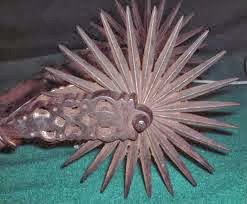
6.Why do you always wear spurs? Why are your spurs so big?


Not all western riders wear spurs. Not all western spurs are big.
Most of them look like this:


It has to do with the relaxed leg. Our leg is off, in order to cue, we make contact with our calf, then, if needed, turn our foot out  to make contact with the spur. Long legged riders will wear a spur with a longer shank. This allows contact with less leg movement. The spur is used for turns and to lift the back, not to increase speed. If you watch a good rider, you will very rarely see a spur actually touch
the horse. 


7.Why do you always have your spurs on? 

We leave them on our boots, so we never lose them, and they sound cool when we walk.

8.Why do all your horses go downhill?

Cowboys need bursts speed, turns and stops from their horses. Quarter horses can run a quarter mile from a flat-footed stand still in less than 21 seconds. They reach speeds up to 55 MPH. Some of them do, indeed, stand higher at the croup than at the wither.


We don't need this.


Horses that can do this...

and this....

are built like this.
This particular horse earned well over $100,000 dollars during his career.
He is now enjoying life as a ranch horse, a leading cow horse sire and a beloved family member.
He is sound, sane and famous for his sweet nature.
We should be so lucky as to ride a horse built like him.

Why don't cowboys wear a helmet?

Because cowboy hats keep rain off our backs and face, stop us from getting sunburned, keep wind and dust out of our eyes, and make us look fricking amazing.

Cowboy hat awesomeness.

Western helmets do not.


Wednesday, January 29, 2014

This, Not This


The more I think about breeds, crosses, bloodlines that trace back to....the more I, well, keep thinking. 
I guess I have more questions than opinions.
Because I like having a horse bred to do the stuff I want to do. I don't like the genetic weakness that comes with breeding for a specific look or ability. I guess it's that simple.
Same things with dogs. If I need to hunt, be protected, find stuff or herd sheep, well a dog bred help me would be great. 
By choosing to adopt at the pound, my chances of success for a specific test are much smaller. 
Except some of my best dogs have been mutts. 
Here's where my thinking always goes...

I would love to have one of these.


But I definitely don't want one of these.


I have dreams of owning one of these and seeing if it would make as kick butt of a cow horse as I think it would.
Same breed, ew, ew, ew.

I have wanted one of these for years, and I'll be honest, I love the color and the spooky eyes as much as the toughness, intelligence and loyalty.

See what happens when people are attracted to a breed because of it's color? Merle dogs bred with merle dogs can produce deaf and blind puppies. Some are born without eyes.


"Get a mustang," I'm told. "They are smarter, stronger, have better feet and their bloodlines trace back to the barbs that came over with the conquistadors!"
Well heck, if they all look like this Kiger, then let me jump on that boat.


Small problem, 90% of the kiger mustangs I come across look like this.

...then there are other rare gene pools that look like this, and I don't want to ride or clean up after either one of these.


If I wanted a big ass drooly guard dog (I don't) I might look at this.
Unfortunately, since WWII, the dogs have turned into this. I really don't want this.


I could get one of these instead. Smaller, cheaper, longer life span, same concept.

I'll be honest. I like color. I really do. Except I want my Krazy Kolor Choices to look like this.
Not this


I can't imagine having a dog without a  nose.
However, I would send my firstborn to a convent if I could have this Pugahoula.

Last but not least, my own beloved  breed, the Quarter Horse. They have turned into too many different types within the breed. Almost to the point of no return. You can still find sound, good minded, athletic horses within my breed, but there sure is a lot of chaff to wade through before you find the grain. 


This is what I want to ride.
Not this (yawn)


...and never, ever this.


Friday, October 11, 2013

My Mother is My Father's Grandma


My, but I've been chatty. Please remember, for every successful post there is another failed attempt on finishing this week's food column.

I have been reading a very educational, fun, thought provoking blog lately, Terrierman's Daily Dose  http://terriermandotcom.blogspot.com/. One of you turned me on to this blog, and while I'm thanking you mightily, I also hate you, just a little.

He has already worked through, studied, researched and written about many of the things I've been just starting to puzzle out. He is thoughtful, opinionated, published, uses bigger words and has better sentence structure than I do.

Being the housebound, OCD lunatic I've become, I can't be happy thinking, Oh, well, if Terrierman said it and it's a line of thought I've been considering, it must be right. Not me, I have to check his resources, read his references, read counter arguments and then try to think my own thoughts. So no, I won't become a Terrierman parrot, I promise, but he is fast becoming a reference I trust, so you'll be seeing his name here and there.

Where he hooked me was when I read his hard look at the AKC and the destruction of dog breeds. My idle thoughts that led me to his posts on the subject was pretty simple. I read an article about several AKC breeds of dogs which were going extinct. The Old English Sheepdog, English Setter, Dandie Dinmont Terrier, Otter Hound and Lancashire Heeler were all on the list.

Can you call the disappearance of a man-made creation, that has only been around for the last 140 years or so extinct? Wikipedia defines extinction as:  In biology and ecology, extinction is the end of an organism or of a group of organisms (taxon), normally a species. The moment of extinction is generally considered to be the death of the last individual of the species, although the capacity to breed and recover may have been lost before this point.

The definition of species: a group of living organisms consisting of similar individuals capable of exchanging genes or interbreeding. The species is the principal natural taxonomic unit, ranking below a genus and denoted by a Latin binomial, e.g., Homo sapiens

The definition of breed: a stock of animals or plants within a species having a distinctive appearance and typically having been developed by deliberate selection.

When I thought a little more and did some VERY casual research, I wondered, if a breed can actually become extinct, when does it become official? 
Here's an Old English Sheepdog in 1860


So, was the Old English Sheepdog extinct here? This is a show dog in 1937.
 It's certainly not the same dog as the one pictured above.


It definitely has to be extinct here, because at this point,
I'm not sure it's still a dog.


Then I thought I might be making things too complicated. Dogs were bred to suit human fancy. So, if we needed a gun dog, a herding dog, whatever, we bred them, right? At least it went that way until we started breeding dogs AKC style, based solely on looks and tossed out any concerns about health, ability or temperament.


I found some drawbacks to the breeds that were on the AKC endangered list.

On Old English Sheepdogs :  They are really big dogs...80 pound average. Inbreeding has made it difficult to find dogs that aren't high strung, nervous and sometimes aggresive. These great big dogs are rowdy, think jumping on Grandma, herding the kids, dragging you down the street...they are notoriously strong willed, messy, hairy, slobbery aaannnnd very, very farty.


Then there's the health issues:  deafness, cataract, gastric torsion, otitis externa, progressive retinal atrophy (PRA), cerebellar ataxia, retinal detachment and hypothyroidism, or major health issues like canine hip dysplasia

English Setters:


Think, high, nervous energy. Although these dogs are gentle and sweet, all that can go straight to hell if you aren't going to get them out where they can run. They are known for separation anxiety too, so keeping the in a crate for 10 hours aday is a very, very bad plan.Stubbornness, hard to housebreak, heavy shedding and silky, easily matted hair round ou the list.

Health Issues: congenital deafness, autoimmune thyroiditis, canine hypothyroidism, hip and elbow dysplasia, allergies, and cancer.


Dandie Dinmont Terriers:


These cute little dogs look like they were made for Aunt Edna's lap don't they? If your auntie is loaded...they carry an average price tag of $800 to $2500 dollars, yes, that's per puppy, and really gnarly, then maybe. The cost isn't because they are better, it's because there aren't very many of them. Think teeny, tiny gene pool. Dandies are known to be self-willed and independent, aggressive towards other animals, and not prone to use an indoor voice. But they have really cute haircuts, I'll give them that.

Health issues: Glaucoma, cataracts and corneal ulcers. Intervertebral disk disease, hip dysplasia, and luxating patella (loose knees). Luxating shoulder can also occur. Allergies, hypothyroidism, Cushing's disease and lymphosarcoma.


So. My next thought was, maybe these dogs don't need to be saved, resurrected, considered endangered, or anything else. Maybe, they are fading away because there is no longer a consumer demand. Since the breeds themselves were created for our personal pleasure, why shouldn't they fade away as they become obsolete? It's not like we'd be eliminating dogs, just no longer breeding the ones nobody wants. 


Who really needs a giant, hairy sheep dog? Bird dogs are becoming harder to find, because there aren't as many people using them. It's interesting to think about what kind of breeds will develop in the future. You know, after Armageddon, when we need our dogs to start working for a living again.  

If dogs were bred like horses, developed because of what they do instead of what they look like...well, except for color, we do like to breed for color.


That's not working out either. 


Take quarter horses for example. The hottest bloodlines come from the winners in the show pen, right? The electric flash of a top cutting horse, the slides and spins of a top reining horse, the elegance of a top pleasure horse. OK. Stop laughing, I mean it.


Equine breeders may be breeding for ability, but what about soundness, longevity, temperament, general health?  


Let's think about HERDA, HYPP, thin soles, bad guts, Overo Lethal White Syndrome...


Where did my train of thought take me? Other than to Terrierman, they took me down a pretty broad path. I'm starting to think over the last couple hundred years, breeding animals is more about playing God than continuing on with the animals that work best with us. We're just not that good at it.


My other problem is, mugwump that I am, I just love my inbred cow horse. I love who she is and what she can do. I'll never forget telling the Big K - " Training this filly has made me realize that up until now, I've been training chihuahua's to be sled dogs and I finally got me a husky."


Plus, while researching the rare breed list, I came across this little guy, the Lancashire heeler  http://dogtime.com/dog-breeds/lancashire-heeler. How cool is he? Everything I read says this is my kind of dog and if I ever get a chance, I'll be getting one.