Showing posts with label Brockle Games. Show all posts

Wednesday, April 15, 2015

WTH is Brockle and the Genetic Wheel of Fortune

I was asked in the comments - Why not do another test with a different company and compare?

My response was so long that I decided it was another post.

There are two short answers, and then there's the long one. I'll give you both.

1. Tests cost money.
2. I'm happy with the results.

Here comes the long one.

I have no desire to prove or disprove the accuracy of the Wisdom Panel test. What I read about the testing was enough for me to become curious. I believe the test comes as close as is currently possible.

We could go back and forth all day about whether the test is right or wrong. I can find great arguments on both sides and I'm sure you can too.

For me, this leads to unproductive and boring discussion. As you all know, when that happens around here,the conversation turns into an endless circle of argument. When I get bored I become snarky, then the trolls come slithering out and there we go.

What I got from this test went so much farther than the results. It launched me on a whole new learning extravaganza. I got the bare bones of dog DNA studies - and a brand new look at dog breeds.

I've gained insights on breeding, eugenics, form before function and vice versa, and it's leaked over to my horse world.

I've gone way deep into inherited behaviors. I've learned why a Chihuahua is almost the same dog as an Australian Shepherd.

I learned  way more than I ever wanted to about white-coated hairy dogs. I learned that the difference between masked white, extreme white, piebald, ticking and the Irish Spotting Gene. I know that one variation or the other of those white genes can be carried in every breed listed on Brockle's chart.

The study was fun. If he had come back as a beagle Bouvier mix it would still have been fun.

I'm guessing DNA tests will become more accurate as time goes on. When I can read about the increased accuracy of these tests, I might just do it again. That would be when I'd be interested in a comparison.

Wait! I just learned this one.

Both GSD and Keeshond can and often do carry the masking white gene. If two white carriers breed, even if they show no white, their litter can potentially be 25% white, 25% homozygous non-white and 50% heterozygous non-white.

The possibility is there for one of Brockle's parents to be white, and then all he would need is a white gene from the other side. I envision a back yard breeding of two dogs thought to be huskies, white shepherds, collies, wolf hybrids or some other thing.


Friday, March 6, 2015

WTH is Brockle?

Gotta admit folks. The more I learn about this genetic stuff, the more I'm sure that I don't have a clue what my boy is.

A thought occurred to me, what if one parent was homozygous? The one with the fluffy white coat?
I think that's about where my brain froze.

Plus, if my results come out like this one...

I saw this dog on the Wisdom Panel Dog Community. Wow! I thought. This one is close.
BUT here are her test results:
25% Australian Shepherd, 25% Bloodhound 25% Boxer 25% SharPei
If Brockle's results are similar, well, I guess we found his mom. But if they are this screwy with different breeds...I'm doing it again, because I just can't see Bloodhound, Boxer and Sharpei in the dog above.


These tests periodically come back with some really wonky breeds listed. I'd say 80% of them looked about right.

Brockle's second test is being processed, so it's about time for me to suck it up and guess.

It was so hard to sort out my mutt by his looks, I went back to who he is. I tried to think through his behaviors, then went back to the breeds most likely to have them.
I also thought hard about the behaviors he doesn't have.
I tried to keep in mind he's a neurotic pound dog, and a lot of his behaviors have been man-made.

Brockle doesn't herd at all.
He will block and guard a line, but he doesn't drive or herd.
Brockle has a very, very high prey drive, but he doesn't bite.
He will, however, bite and try to seriously harm anybody who crosses his perceived boundary toward me in a way he finds threatening.
He stands outside every night and does his "night bark." It's a loud, evenly spaced bark. I'm not sure, but it feels like a warning to the predators that frequent the park behind our house. It lasts 10 to 15 minutes.
If the coyotes, bear or whatever are at our back fence, he goes nuts, chewing at the fence until his mouth bleeds.
He doesn't try to chase deer, horses, cattle etc. He leaves rabbits in hutches, yard fowl and goats alone. He can be triggered by cats and wild turkeys, but again, he has no interest in biting them.
He doesn't cower or slink. If he's confused he stands tall and seeks eye contact.
He has OCD. There's a list of behaviors and they're kept under control by keeping his his brain active and him exercised. We're also working on relaxation techniques that are helping a lot.

Another thought. The dogs who came together to create Brockle, no matter what their breed, were more than likely not high quality dogs. The dog called Blue Heeler on a five acre ranchette looks nothing like an AKC Australian Cattle Dog. I have heard (don't know for a fact) that AKC Border Collies don't have the instincts of a working BC.

Brockle's guarding behavior and night barking are very similar to the Guardian Breeds. Great Pyrenees and Anatolian Shepherds are fairly common around here.

Most dogs who chase critters will kill them if they catch them. Brockle doesn't even bite. He will gleefully roll a dog in the dog park (why we don't do dog parks) but he's never hurt one. Saluki's chase and hold prey, but don't kill it. Catch dogs (mainly bully breeds) do too, but they physically hold the animal. Brockle is a circle and bark kind of guy. I thought some of you lurcher folks could give me some insight on this.

His boldness doesn't come from being fearless. It's like he has to respond. Some Malinois lines carry a gene that stops them from backing or running off. The more dangerous the situation, the more fearful the dog becomes, the harder he holds his ground and the fiercer he becomes.

Good Collies, BC's, Shelties, Australian Shepherds and Heelers will ignore the farm animals and focus on their job alone.

Doberman Pinchers, Shelties, Bull Terriers and German Shepherds carry a gene that causes OCD behavirs.

He's obedient, protective and always at my side.

He's the smartest dog I've ever known.

My vet said, "Don't discount the BC, those brains came from somewhere."

So.

I started with Australian Cattle Dog, simply because I think every mutt in the southwest has some heeler in there. Then, although my trainers disagree, I think he has some German Shepherd in there. Then, I think we have a strong Great Pyrenees influence and the speed and light frame could come from a whippet, Border Collie or Rough Collie. Or any of the Belgian Shepherds. Or...


Last chance to change your votes...


Saturday, January 17, 2015

Decoding Brockle - Trying to Understand How DNA works


This is all Brockle's fault. He has been a confusing puzzle of a dog since the day we met. I have owned several dogs in my life. Our relationship was uncomplicated and easy. Then I met my boy. He is complicated in ways that freak me out a little. He piqued my interest. 

My confused thoughts are written in blue and corrections from brilliant readers will be added in green.

His quirkiness, sense of humor and fierce loyalty caught the eye of others. The guesses at what was in him were wild and varied. It got me studying dogs in a way I'd never considered. 

I started by looking at dog DNA. Yuck. 

This is the kind of stuff I am really bad at. I try to process the information and end up going blind and thinking about horses. My difficulty understanding this kind of thing is the reason I was considered stupid, lazy or both, in school. Since those days of pure hell, I've discovered I can learn if I'm interested enough, and can break things down far enough.

I'm really hoping that those of you who get this more than I do will help me clear up the foggy parts.
Here goes: 

Most of the DNA in a cell is stored in the nucleus, but there is a little tiny bit found in the mitochondria, the mitochondial DNA (MtDNA). Researchers studying dog DNA use mtDNA, to compile complete genomes (a dog's complete set of DNA).


The reason researchers studied mtDNA is because they reproduce asexually, independent of the rest of the cell. Regular DNA comes from both parents and mtDNA comes only from the mother.I had a killer Eureka! moment when I realized even these teeny bits of DNA don't need no man to take care of business.

Sexual reproduction creates rapid genetic change in each generation, since the genes from both parents are mixed. On the flip side, mtDNA can change only by mutation, which happens at around one or two percent every 100,000 years.


That means that mtDNA can be used kind of like an evolutionary clock, or maybe calendar is a better description, and show when and where dogs developed throughout history. 

Wolves and coyotes differ by about six percent in their mtDNA, and, according to fossil evidence, separated from a common ancestor about a million years ago. 

Wolves and dogs differ by about one percent; using the wolf-coyote time scale, this suggests that they parted company about 135,000 years ago.

Recent studies show two groups originally split from the wolf, rather than the single event of domestication originally thought. Domestication began in two separate and distinct populations in East Asia. One group developed from the first domestication and the second group came from specific breeding.(Does "specific breeding" mean humans started screwing around with breeding dogs from the get go, or are we talking about limited gene pools?)

There is a competing study that argues that the domestication of dogs happened between 18,000 and 32,100 years ago...in Europe. It is thought European hunter gatherers had dogs long before humans developed agriculture. I say, whatever, I've got my story and I'm sticking to it.

These two groups interbred and backcrossed (breeding with parents and siblings) Backcrossing is one factor in creating breeds (I think-- this is one of my foggy places), because the common origin makes dogs with similar structures.

Then, the two groups became four. Researchers established four matriarchal lines according to mtDNA differences. The largest line includes the genes of most known breeds. The other three formed later and encompass more specific and unique breeds. 

mtDNA stops being useful at this point. It can only show mutations prior to the creation of the modern breeds.

Aaaand it got more complex.

In order to determine the lineage of actual breeds, science switched to loci research, which is based on the location of genes on chromosomes. 


Loci research detects genetic changes that might have occurred because of genetic drift. From what I understand, genetic drift is the random movement of a gene from one chromosome to another. This genetic bar hopping can cause huge changes in dogs in a very short period of time.

Genetic drifts happen in very small populations and after severe reductions in populations. If there are only five or six dog breeding, then the barhopping commences. The same thing happens if say, all the long eared dogs die off and again when a new population of dogs forms from a small group.

Whisper_the_Wind wrote: 
"Genetic drift is when population gets isolated and either 'concentrates' an allele, or 'eliminates' the allele from the population, not so much the gene moving from chromosome to another (happens much more often in plants). With humans selecting for traits ever since dogs started looking to us (I wonder who was really domesticated), the genetics of dogs may never really get clarified." 
 So..dump my WONDEFUL bar hopping visual and go to a frat house with a drunken hazing party in the basement...or said party is busted and all involved members are thrown out of the fraternity.

It gets even more complicated, but I'll be honest, allele frequency made my head hurt, and I decided I had got the drift, (snort) and could move on.

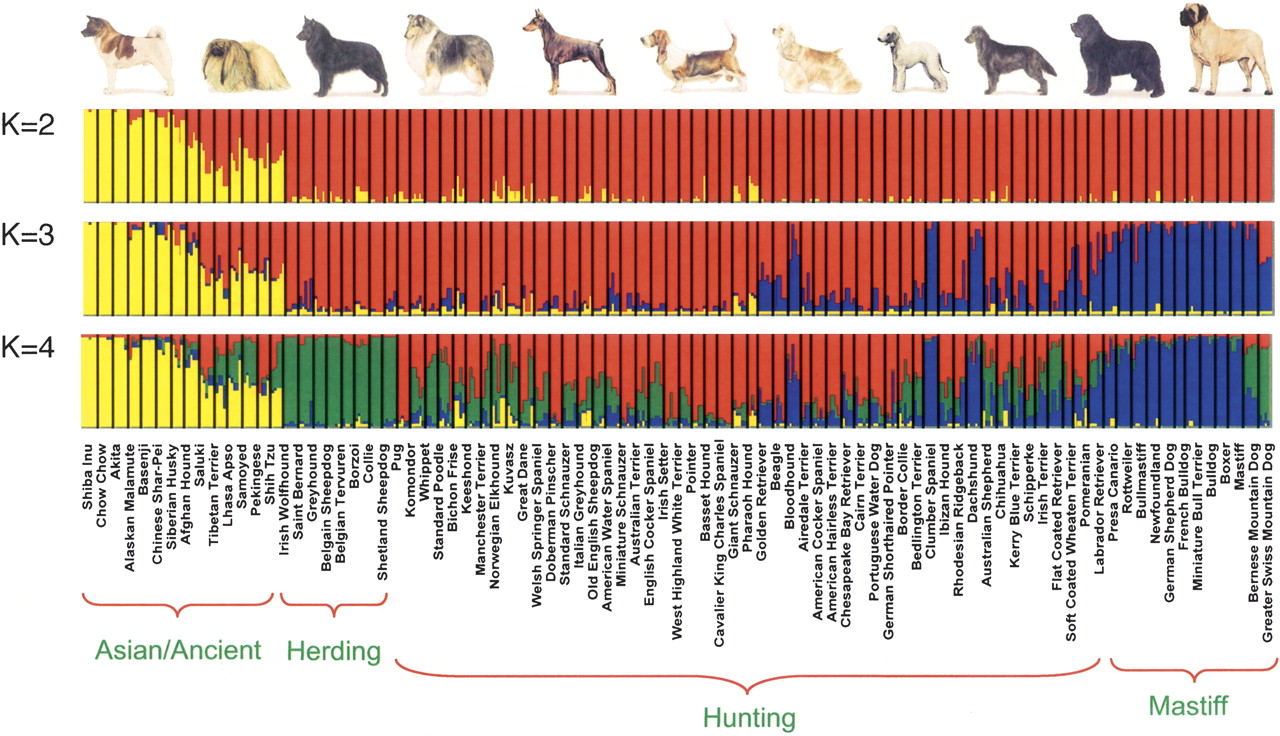
The differences between these bar hopping genes let researchers distinguish different breeds. Then, they found dog breeds can be clustered by ancestry.

So far, these clusters have been broken down into three groups. All breeds of Asian origin, mastiff type dogs, working type dogs and hunting dogs. 

This is where it gets crazy. At least to me. The scientists built themselves this cool map.

You can find it here: http://www.bu.edu/synapse/files/2011/11/F2.large_.jpg


K=2 (yellow) represent the cluster of Asian dogs
K=3 (green and red) represent the cluster of hunting and herding dogs
K=4(blue) are the cluster of mastiffs.

You can see how they overlap.
I also wonder if the biggest group, the hunting dogs are the breeds contained in the largest mtDNA line. 

According to those crazy loci German Shepherds are actually Mastiffs. The two genetically closest breeds to said GSD are the Newfoundland and the Boston Terrier. Border Collies are hunting dogs and Borzoi are herding dogs.

When I think about it, there is a crazy kind of sense to this. We're talking about Nature. When those European hunter gathers decided to keep herds it was their wooly rhino killing Border Collies they turned to for help hanging on to them. We were the ones reshaping the genetic dynasty  of our dogs. It's what we do best.

While I was choking on all of this info I noticed there is an awful lot of theory being used as fact. The words maybe, thought and might showed up a bunch during my research.

It got me thinking about criticism of the Dog DNA tests. I often read, "I have a little white fluffy dog and his test came back saying he was part Keeshond. Seeing how genetically close some of these breeds are, in spite of the visual differences is giving me something to think about.


Monday, January 5, 2015

Guess What I Got?

I got a pretty cool Christmas present.

My husband gave me the Wisdom Panel 20 Dog Breed Identification DNA Test Kit.

I guess he's tired of listening to my eternal speculation of what the heck my dog might be.


                                               There has been lots of helpful input.


Ideas I might never come up with on my own.


                                                 Of course I have my own theories.


I'd love some input from you guys, but I'm aware you may not think this as much fun as I do. So I'll sweeten the pot. I just ordered my panel. It will take a few weeks to get it, do the test, send it back etc.
 I'm going to share some of my research with you, because trying to understand my dog has led me down some fascinating paths about genetics, nature vs. nurture etc. So sporadically over the next month or so, I'll bring up some of this stuff. I'm hoping it will lead to some good discussion that relates to both canines and equines.

Once you think you have an idea of what Brockle might be, send it in through the comments. We'll have a Brockle Decoded pool. The one who comes closest will win this:


This is a print from a fantasy series I drew in the late 70's...stop laughing, we all draw at least one unicorn, right? Anyway, signed and numbered, ya da da da.

I'm planning on waiting to guess until we go through our discussions on ear shape, color, instincts etc. Then I'll leave my answer with the kidlet and we'll see how close I can come too.

OK? Ready, set, GO!